Franco-Hungarian relations
Lecture on September 13, 2025,
"Love and disenchantment, Hungary and France"
as part of the ceremony in honor of Prince Ferenc II Rákóczi.
First part: Love…
Second part: disenchantment
By André Bourachot
|
[

This document is also available in PDF format, 8 pages, 5 694 KB.]
We will now take a big leap forward in time and discuss Franco-Hungarian relations after 1870, leading up to the 1914-1918 war and the
Treaty of Trianon, which was so disastrous for Hungary. Before we get there, however, we must recount a few events that would have a major impact on these relations.
First, there was the rise of
Prussia under
Bismarck, who wanted to make the kingdom the unifier of Germanic diversity, which at the time consisted of some forty sovereign states under Austrian rule. A clash of power ambitions was inevitable. It led to war, and in 1866, after Austria lost the
Battle of Königgrätz, nothing could stop Prussian expansionism.
|
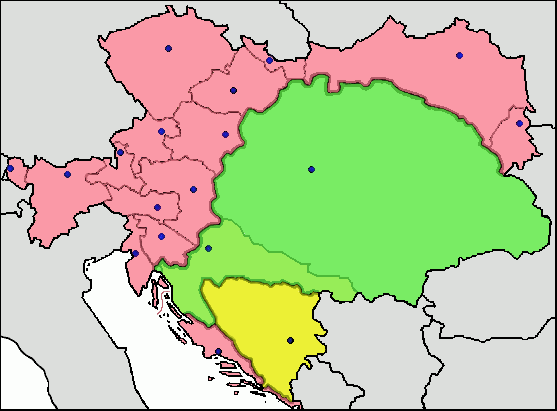
Austria-Hungary around 1900; Austria in pink,
Hungary in green, Bosnia in yellow
|
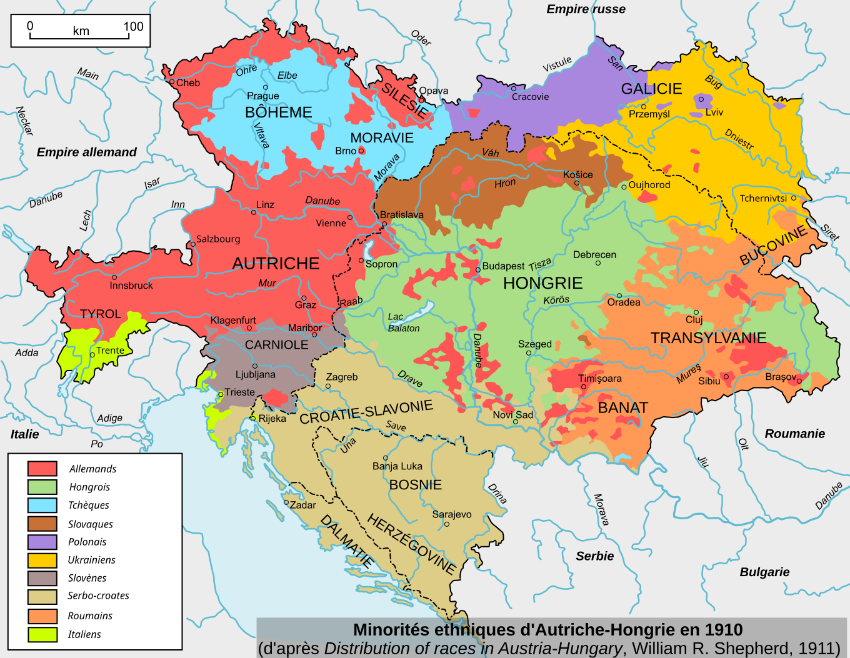
Then there was the birth of a curious phenomenon, the Austro-Hungarian dual monarchy. After signing an agreement known as the “Compromise of 1867”, Austria and Hungary (680,000 km²) created a new entity, a kind of monarchical federation that nevertheless encompassed many other nationalities.
When we talk about compromise, we mean that each of the two monarchies made concessions to the other. Hungary regained a certain degree of autonomy, but not in all areas; diplomacy, defense, and finance remained largely in Austrian hands. It should be noted that from this date onwards, the term “Austria-Hungary” was used exclusively, and all policies pursued by the new entity were credited or blamed to it. No distinction was made.
|
|
Ethnic minorities in Austria-Hungary in 1910
|
Finally, the third event was that France was about to change its political regime, which would have profound repercussions. In 1867, France was ruled by Emperor Napoleon III. After Sadowa, he sought an alliance with Austria to counter German power, but without success. Austria, for its part, had attempted to return to an alliance with France against Prussian hegemony. The Franco-Prussian War broke out in July 1870, and France's defeat created a new situation in Europe. In 1871, the Treaty of Frankfurt established Prussian hegemony in continental Europe. This permanently changed the balance of power in Europe, and what followed marked the beginning of France's true disenchantment with Hungary.
|
In the fall of 1870, France once again became a republic, the third of its kind, which saw itself as the heir to the Revolution. It was based on universal suffrage, the secularization of society, the fight against the clergy and even religion, the liberation of “oppressed peoples,” and the desire for revenge against Germany, which had become an empire. The ruling party, the
Radical Party, governed France until 1920. Between a third and half of the Radical ministers were and would be
Freemasons. This specific republican ideology was completely foreign to the dual monarchy, particularly in Hungary. The latter, in addition to its attacks on the Church, saw the proclamation of the recognition of oppressed peoples as a threat to anything that could have constituted the recognition of Hungarian minorities.
|
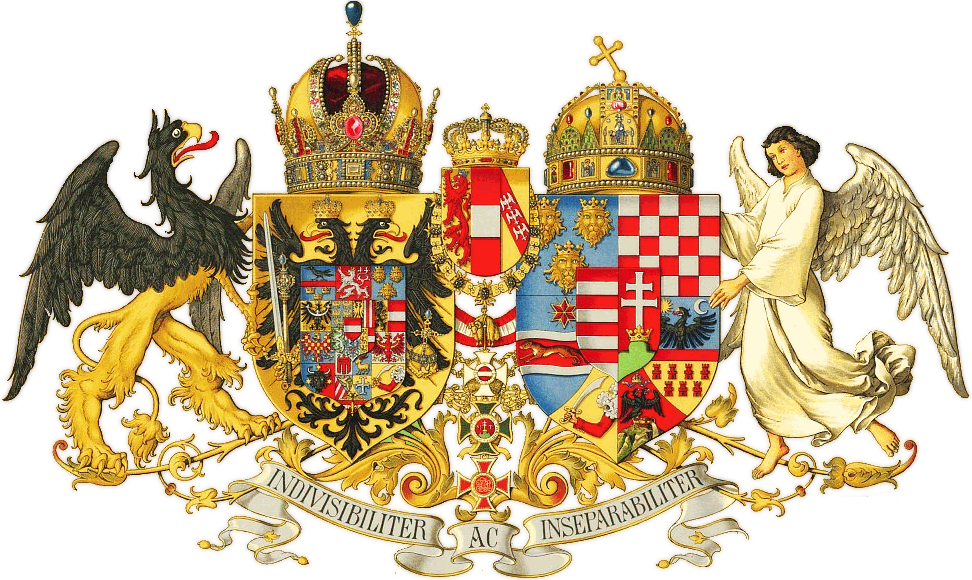
The coat of arms of Austria-Hungary around 1910; Austria on the left, Hungary on the right
|
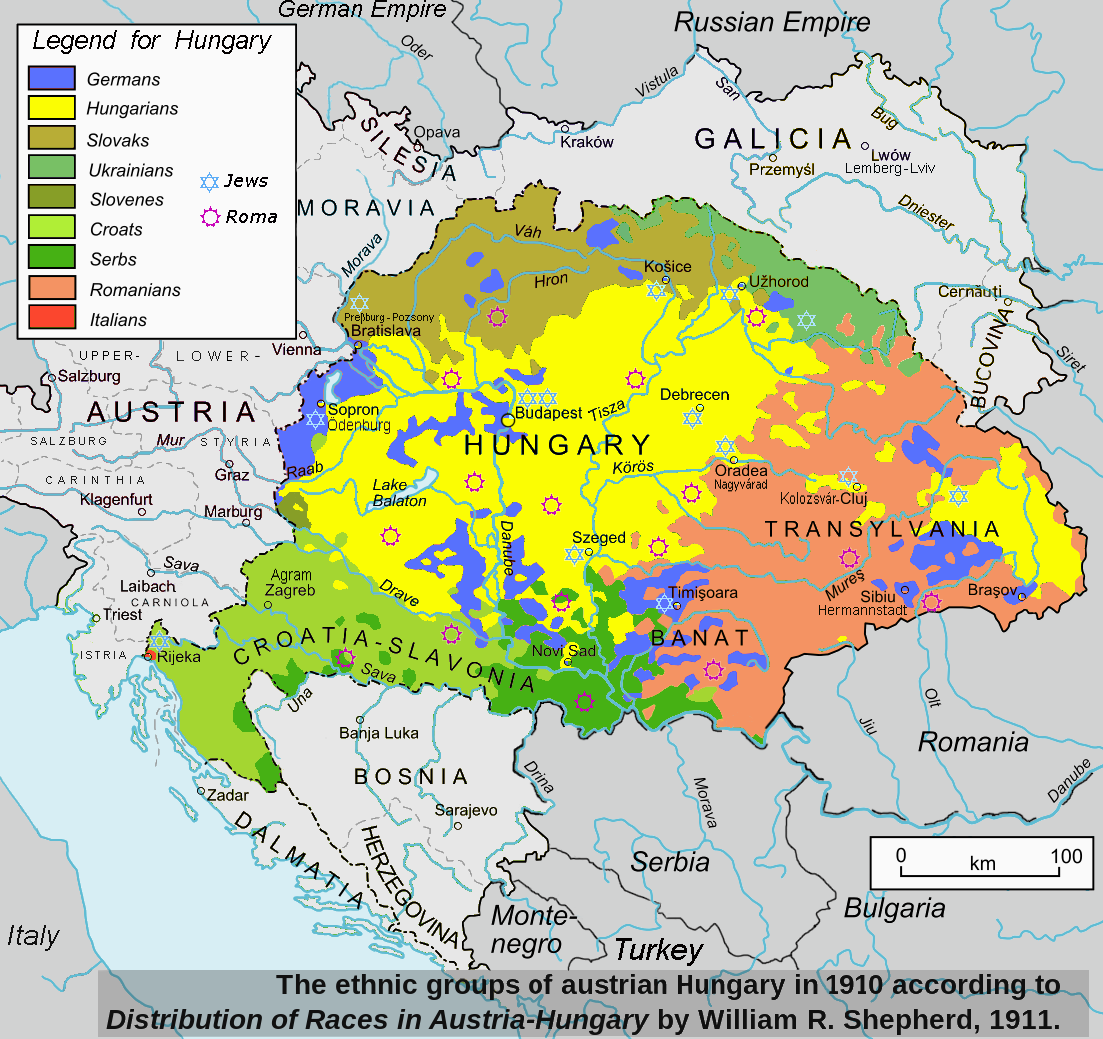
What is more, the coexistence of such different ethnic groups makes no sense to a French republican who only recognizes
nation states and considers Austria-Hungary to be a quasi-feudal anachronism.
|
The ethnic diversity of Hungary in 1910
|
After the compromise of 1867, Austria and Hungary were no longer distinguishable, even though the latter country retained a certain aura among the heirs of the revolutions of 1848. Some still dreamed of separating Hungary from Austria, even though the latter was increasingly being pushed into an alliance with Germany, which is what ultimately happened.
In 1879, Germany and Austria-Hungary signed a treaty, the
Dual Alliance, guaranteeing mutual military assistance in the event of an attack by Russia, as well as mutual neutrality in the event of an attack by another European country (meaning France). Austria, and therefore Hungary, would gradually become the enemy of France, which would become Russia's ally. Although the sympathies born of the revolutionary romanticism of the French left towards Hungary remained, official diplomatic relations were those conducted with an adversary that could become an enemy and wage war against you.
The 1914–1918 War
World War I broke out in August 1914 after the
Sarajevo incident; France declared war on Austria-Hungary on August 3, while Hungary was rather reluctant to go to war. “It can only bring the wrath of the people and the calamities of God,” declared
István Tisza, Hungary's prime minister at the time. The Austro-Hungarian army fought mainly against the Russians and experienced difficult times (the
Brusilov Offensive in the Carpathians in June 1916). Until 1918, the armies of the two countries saw little direct confrontation.
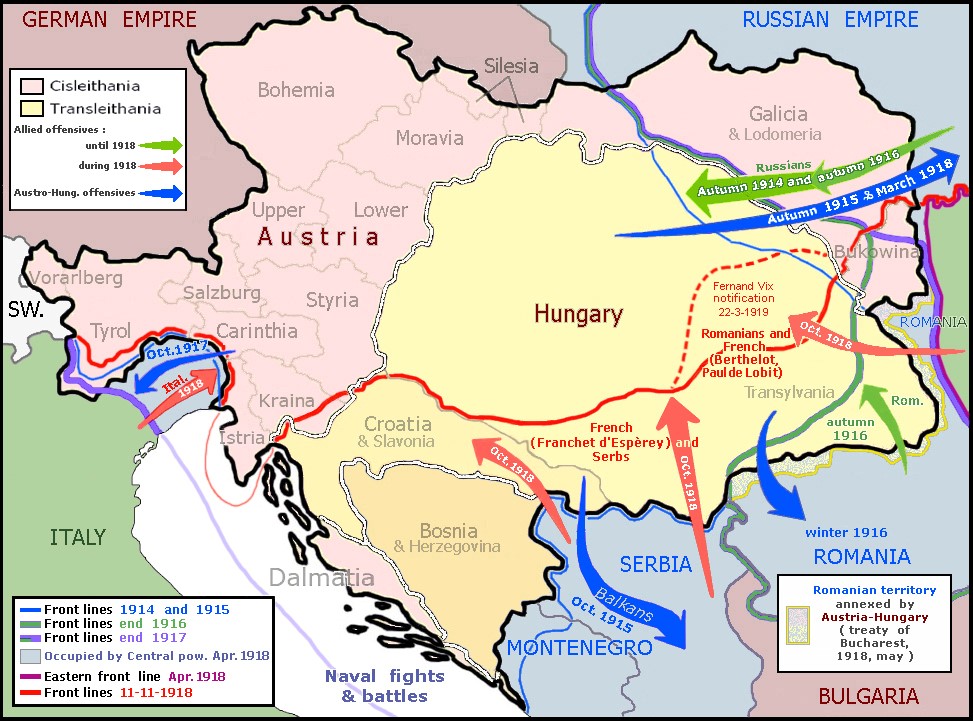
|
The offensive of the Armée d’Orient towards the Balkans
|
It was not until September 1918 that
Franchet d’Espèrey, commander of the french
Armée d’Orient, comprising Serbian, Greek, British, Italian, and other contingents, launched an offensive across the Balkans against Austria-Hungary and its capital, Vienna. The Austro-German armies collapsed and nothing could stop the Allied troops: all that remained for the enemy to do was to request an armistice. I will skip the details; this was the case for Austria on November 3 and Hungary on November 13. Hungary had in fact seceded and proclaimed a republic after Emperor
Charles IV recognized, on October 17, 1918, the right of the peoples of the dual monarchy to form an independent nation.
Yet history could have been written differently! Very early on, Vienna tried to break free from the German alliance and conclude a separate peace. For many reasons, which I cannot go into here, the war went on until the end. An armistice is not peace, and things became more complicated in the months and years that followed.
The Treaties of Saint-Germain and Trianon
First among these treaties was the Treaty of Saint-Germain (September 10, 1919), which would determine the fate of Austria, which had become a republic at the last minute, a move that could have appeased the victor. In fact, no one gave Austria, and therefore Hungary, the slightest consideration. Austria had been a loyal ally of
Wilhelm II and fought almost to the end, mainly against what had been, until 1917, its Russian ally. Its efforts to end the war, which were often rather clumsy and made public at the end of 1918, further discredited it. By late 1917 and early 1918, all members of the French Study Committee responsible for preparing the peace treaties agreed that the question of the disappearance of the Habsburg Empire had been decided.
Clemenceau, who came to power in September 1917, hesitated until early 1918, when Vienna disclosed the peace talks. It should be remembered that his brother Paul had married an Austrian woman, Sophie Szeps, the daughter of an Austrian press magnate. He also often took spa treatments in Carlsbad and had many connections in Viennese political circles thanks to Berthe, Sophie's sister.
When he took power, he was bound by the French government's previous commitments and by the lobbies that influenced public opinion through various means, notably a largely corrupt press and radical parliamentarians. Three entities of the dual monarchy, as we shall see, had already more or less seceded from the kingdom and committed themselves, more or less vigorously, to the
Entente.
The first was Czechoslovakia, which had a serious dispute with Austria. Two Czech politicians,
Tomáš Masaryk and
Edvard Beneš, promoted Czechoslovak nationalism among European and American Masonic networks and presented their contacts with several plans for dismantling the dual monarchy. Czechoslovak legions were created to fight alongside the Entente, particularly in France, and there was no question of not rewarding them for their commitment (a Czechoslovak National Council was created in France in May 1918).
The second was the recurring Serbo-Croatian unrest. Spurred on by Serbia's dynamism (for which France had indirectly entered the war and saved from extinction in 1915), Serbs, Croats, and Slovenes aspired to a common future; how could they be denied it? It should be added that the promises made to the Italians in 1915, notably the cession of territories on the other side of the Adriatic on the Dalmatian coast, did not simplify the negotiations.
Finally, in the southeast of the country, the Romanians had their eyes on Transylvania, where half the population spoke Romanian, and this monarchy chose (belatedly!) the right side despite some hesitation. Here too, a promise had been made to lure it definitively into the Entente camp. This is what actually happened at the end of 1918, when, by entering the war on the side of the Allies, Romania obtained “its” Transylvania and even occupied Budapest for a time.
Finally, the Entente's new partner (not ally),
President Wilson, declared on January 8, 1918, in point 10 of his famous speech, known as the Fourteen Points, which listed the United States' war aims:
“The peoples of Austria-Hungary, whose place among the nations we wish to safeguard and secure, must be granted the greatest latitude for their autonomous development”, which could be interpreted in many ways but opened the door to the secession of minorities!
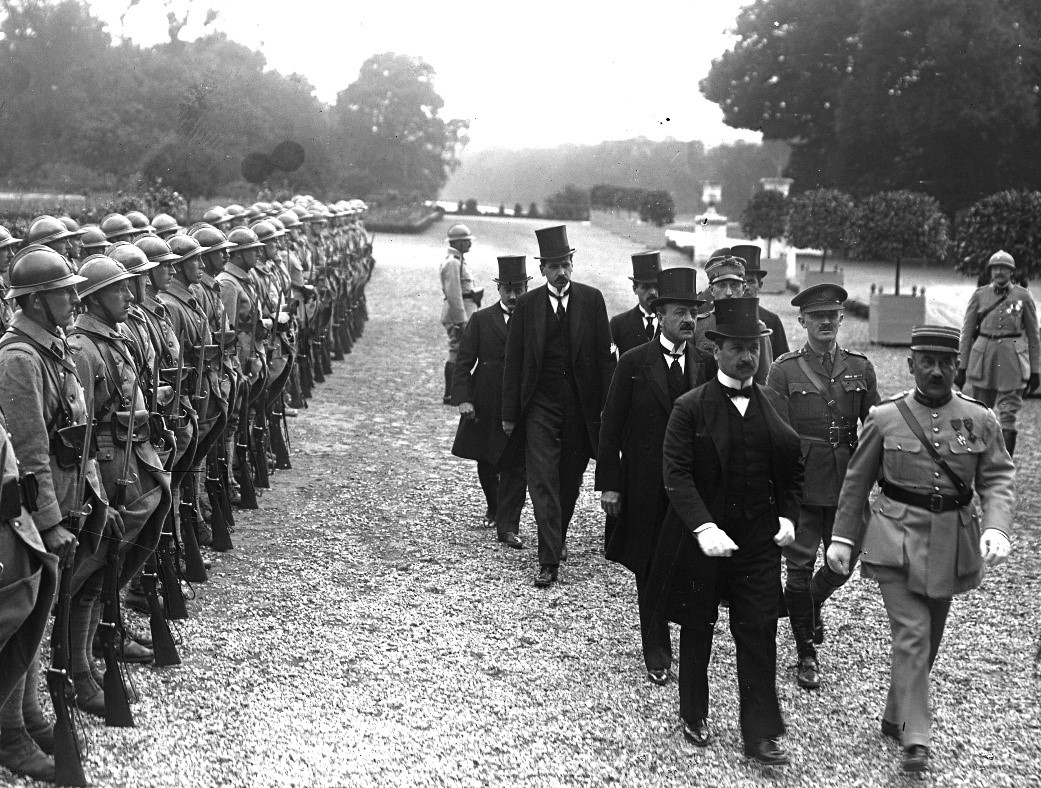
|
The military escort of the Hungarian delegation upon arrival at Trianon.
|
A dual monarchy requires a dual peace treaty, and following the Treaty of Saint-Germain, the
Treaty of Trianon would complete the carving up of Central Europe. What the Treaty of Saint-Germain had planned had to be finalized, and it was Hungary that, in some respects, would pay most of the price, since it was on its territory that the nationalities that would gain their independence were located. The treaty meant that Hungary had to accept the separation of three-quarters of its former territories and their union with neighboring states, known as successor states. As a result, its territory was reduced from 321,000 km² to 93,000 km² and its population from 21 million to 7.5 million. Of the 12 million inhabitants of the detached regions, 3.5 million were Magyars. Half of them lived near Hungary's new borders. The country was reduced to a shadow of its former self; no other nation was treated with such severity. The gifts made to the various nationalities were essentially at Hungary's expense!
The treaty was ratified by the Hungarian Assembly on November 13, 1920, and Charles Huszar, rapporteur of the text, declared in solemn silence:
"On the occasion of the ratification of the Treaty of Trianon, the National Assembly appeals to divine justice and the conscience of all humanity and declares that it considers this treaty to be based on false information, unjust and contrary to the common interests of humanity, that this treaty is not the result of a bilateral agreement based on an examination of the facts and interests of both parties, but has been imposed on us by a single, foreign will... and finally hopes that a fairer assessment of the situation, which will arise when the current passions have calmed down, will pave the way for the redress of the injustices committed under the name of “peace treaty.” As rapporteur for this bill, I am forced to admit that I can find no argument in its favor. However, in the higher and vital interests of the country, I propose that the Assembly vote to ratify it, thus yielding to coercion."
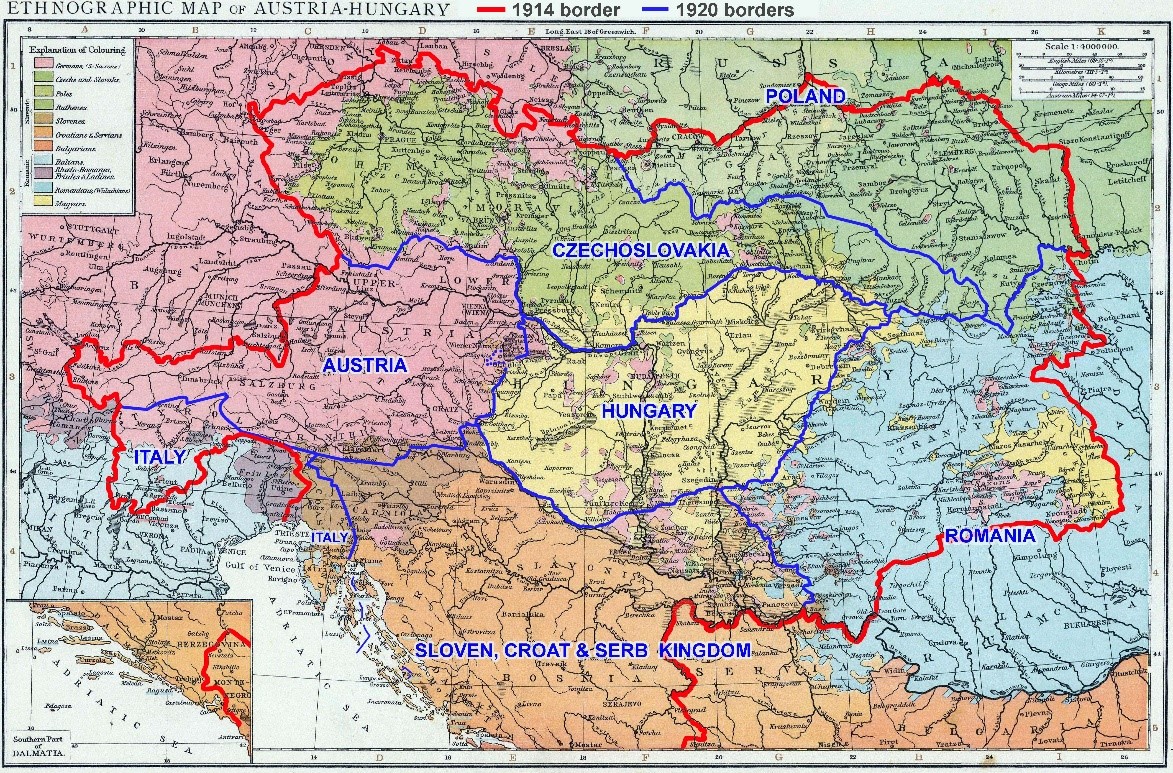
|
In yellow, what remains of Hungary after the Treaty of Trianon
|
Conclusion…
We will conclude here our discussion of the peace treaties of 1919-1920. The Allies failed to achieve peace and, for essentially ideological reasons, laid the groundwork for the next war while inflicting suffering on a nation that deserved better, simply to serve the interests of the victors. Who is responsible? For France, it was partly the spirit of the times and the influence of the great Jacobin Clemenceau, but he was not alone in making the decision.
Lloyd George did not oppose it, nor did Wilson. Once Austria's fate was sealed, so was Hungary's.
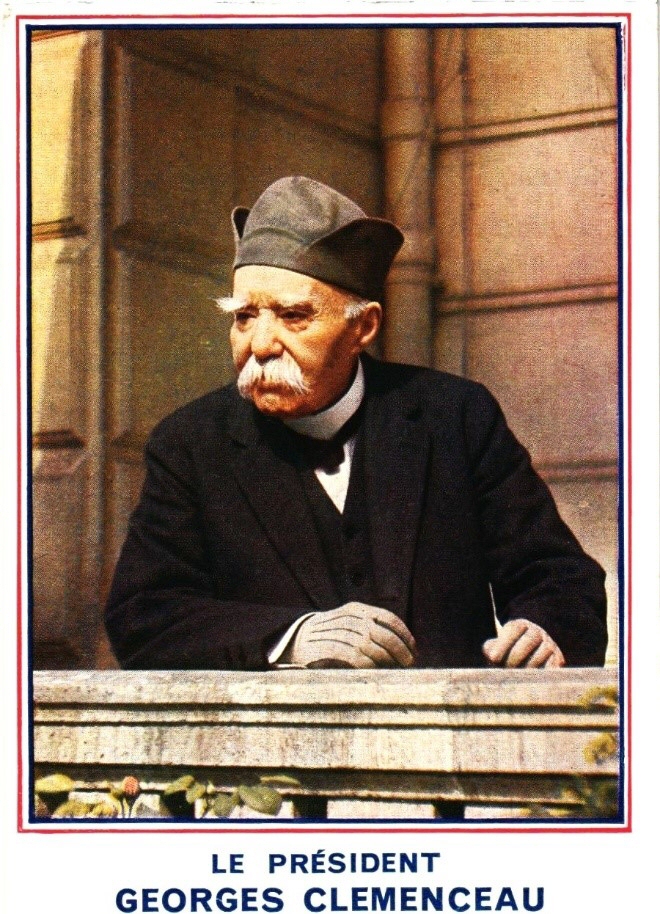
|
Clemenceau, in 1920, whom the Hungarians
accuse of having wanted to dismember their country
|
There were few clairvoyants; one, Jacques Bainville, in France, published a book in 1920 entitled Les conséquences politiques de la paix (The Political Consequences of Peace), in which he described with astonishing foresight the future consequences of the treaties. The successor states that were built were merely scaled-down versions of Austria-Hungary. Here is what he wrote:
"As for the plan according to which the states were distributed and shaped, one need only glance at the map of the new Europe to see that it could only have been guided by caprice and contradiction, or by random sympathies, if not by random discussions between the Allies. Everyone knows, for example, that after declaring that a composite state such as Austria-Hungary was unworthy of existence, the Supreme Council hastened to establish a new Austria in Czechoslovakia, which includes six of the eight nationalities that made up the former state. There will not be a single border post in the Czechoslovak state that is not planted according to the most rigorous scientific methods. As for how long these markers will remain in place and the chances they have of staying there, that was not the concern of the surveyors."
|
The entire subsequent history of Hungary stems from this failed peace, but we will leave it to others to tell you about it.