[

This document is also available in PDF format, 11 pages, 1 688Kbytes]
A whim of Monsieur
By Philippe KOEHL
|
… or how the Count of Provence, that would later become king Louis XVIII, had the project in 1776 of having the river Yerres canalized, in order to reach his castle of Brunoy by gondola.
During their research for the article dedicated to the history of
the Yerres bridges, the members of the SHY (Historical Society of Yerres) discovered in the National
Archives1
an astonishing file describing a project dating back to 1776 which planned the channeling of the river between Villeneuve-Saint-Georges and Brunoy.
This documentary set consists in the following elements:
- Letter 1: letter from Cromot du Bourg to Trudaine dated August 13, 1776, with a brief memorandum (Memorandum 1) describing the planned project
- Letter 2: answer from Trudaine to Cromot dated August 16, 1776 serving as acknowledgment of receipt of the request and informing him of the start of the investigation
- Letter 3: letter from Cadier to Trudaine dated August 21, 1776 reporting on the survey carried out in the field and giving a first overview of the obstacles discovered
- Memorandum 2: detailed description of the place’s topography and the foreseeable difficulties of the project, submitted to Trudaine on September 14, 1776
- Letter 4: letter from Trudaine to Cromot dated September 17, 1776 coming along with the transmission of Memorandum 2 and briefly summarizing the difficulties of the project
- Letter 5: response from Cromot to Trudaine, undated, acknowledging receipt of his letter of the 17th as well as Cadier’s Memorandum, and telling him that he will report to Monsieur within the week.
- Letter 6: letter from Cromot to Trudaine dated September 26, 1776, informing him of Monsieur's finally giving up his project.
Before examining in detail what the project in question consists of, let us at first take a look at the eminent protagonists of this epistolary exchange during the summer of 1776.
- Prominent characters
- "Monsieur"
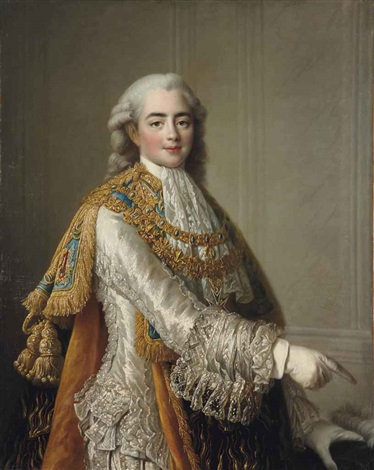
| Portrait of Monsieur circa 1775,
by François-Hubert Drouais
|
Although not being a direct signatory to any of the writings making up the file, the King's brother is nonetheless the central figure in this case of which he is the sponsor. Born in 1755 and titled Count of Provence, Louis-Stanislas-Xavier is the younger brother of Louis-Auguste, crowned in 1774 under the name of Louis XVI. A central figure at the Court, he is second in the order of succession to the Throne as long as his brother has no descendants.
Aged 21 in 1776, he has held for a year the lands of the Marquisate of Brunoy, acquired in troubled circumstances from the previous marquis, only son and heir of Pâris de Monmartel.
He is, according to various contemporary testimonies reported by his biographer Evelyne Lever, a spiritual and relatively cultured character, although totally refractory to the ideals of the Enlightenment. Passionate about classical culture (the works of Horace never leave his bedside), he relies on his trusted man Cromot du Bourg for all his acquisitions, which however seem to be more of a search for prestige than of a constructed intellectual approach or a real curiosity.
With this in mind, the purchase in October 1775 of the Brunoy castles (the “small” obtained from the Marquis de Pange for 200,000 pounds and the “large” from the Marquis de Brunoy, therefore, for 1,670,000 pounds) shows the will to grant himself a “countryside place”, that is to say a residence in an intimate, bucolic and rural setting, as the late King Louis XV and the Pompadour (itself related to Pâris de Monmartel) were looking for during their stays at the Château de Choisy. The Brunoy site also had the advantage of proximity to the game-rich forest of Sénart, thus allowing the Bourbon to indulge in the great family passion: hunting.
But above all these castles are instruments of a political strategy: they must constitute the settings for sumptuous festivals, displaying the power and splendor of the prince who owns them. Thus, the estate was the subject, in a way, of an “inauguration” in the form of a first celebration taking place from July 2 to 7, 1776, sponsored by Madame to celebrate the healing of her husband (from measles)2. For five days, wild entertainment including plays performed by the Comedians-Italians, tableaux vivants, sometimes nautical, and fireworks delighted the guests, most of whom were close friends of the Prince3. This success encouraged the Count of Provence to think bigger, aiming at hosting the royal couple, in a way that he imagined even more sumptuous.
|
-
- Cromot du Bourg
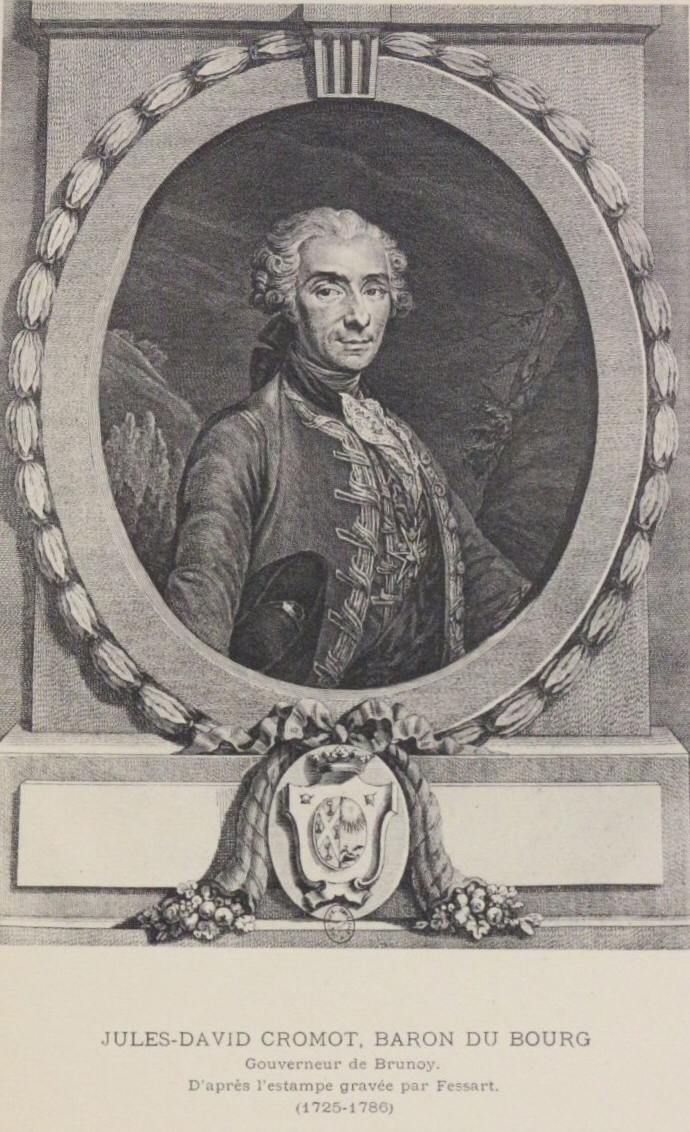
| Portrait of Cromot du Bourg by Fessart, circa 1750
|
In more than one way, Cromot du Bourg 's career is the archetype of an Ancien Régime royal agent’s: son of an army captain ennobled in 1761, Jules-David Cromot made his way in the royal administration and in particular in the financial field where he started in 1745 at the Contrôle Général as “finance clerk”. He progressed until he became "M. de Machault’s favorite private secretary4", as Marmontel describes him in his Memoirs5.
His central position in the kingdom's budgetary administration provides him, in addition to a recognized mastery of financial matters, with a solid network of knowledge and officials. It also places him at the heart of the political game whose intrigues he does not disdain. He is described by his contemporaries as a brilliant mind but a hard and implacable man, hardly sparing his peers or even more so his subordinates.
He left the Contrôle Général in 17706 to be appointed by Louis XV as Superintendent of Finances of the Count of Provence, in charge of the creation of the latter's House when he came of age, then also regained in 1774 the office of Superintendent of Buildings and Manufactures, Arts and Gardens.
Occupying this prestigious position with authority, Cromot seems to have exercised considerable influence over the prince whose patrimony he managed, extending his prerogatives beyond financial matters to the point of guiding the choices of acquisitions of the count, in a special and close relationship quite unusual at that time7: Dubois-Corneau even describes him as a “henchman”.
Having conducted the purchase of Brunoy in October 1774 (by happily forcing the seller's hand, again according to Dubois- Corneau8), it is therefore very natural to find him in command for the project at stake, concerned with beautifying the domain that he acquired for the prince and of which he was the titular governor, but also with preserving the latter's funds.
|
-
- Trudaine
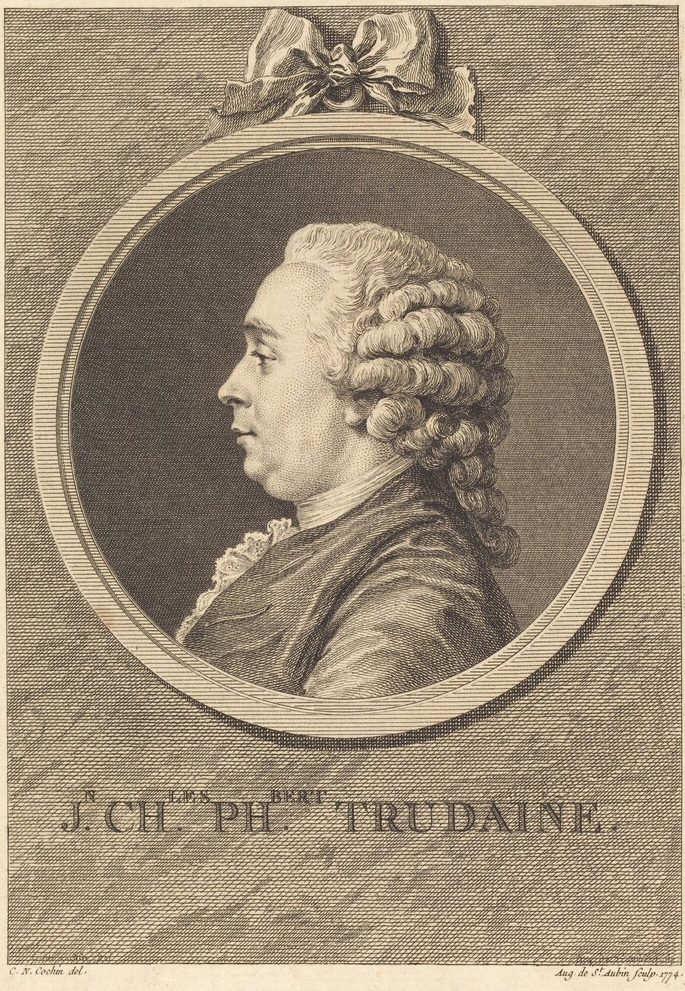
| Portrait of Jean-Charles Philibert Trudaine de Montigny
by Augustin de Saint-Aubin, 1774
|
The Trudaine9 in question here is not “the great Trudaine” [Daniel-Charles Trudaine (1703-1769)] but his son Jean-Charles Philibert Trudaine de Montigny (1733-1777), who succeeded him in his functions of financial intendant, director of commerce and administrator of Bridges and Roads.
Under their authority, the kingdom experienced an extraordinary improvement in transport infrastructures and particularly its road network, making it one of the best in Europe. He also continued his father's work of cartography, allowing the creation of the " Trudaine atlas10", a set of 62 volumes bringing together 3,000 illustrations, representing the Realm’s roads and their immediate surroundings.
An enlightened mind, originally a chemist, friend of Turgot, Trudaine de Montigny has a global vision of the impact of communication channels on economic issues: he therefore appears to be the ideal interlocutor for the request that Cromot transmits on behalf of his master.
|
-
- Perronet
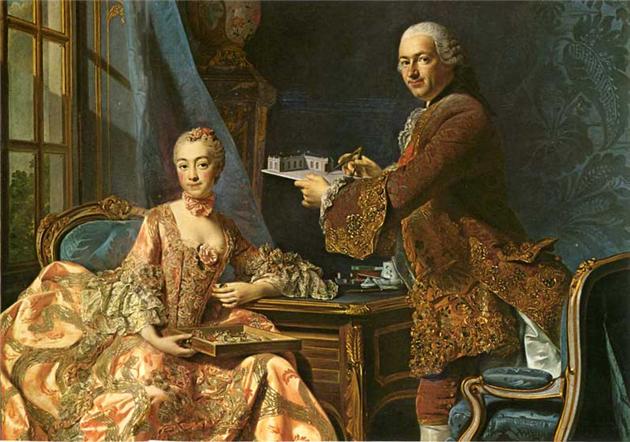
| Supposed portrait of Jean-Rodolphe Perronet
and his wife in 1759
by Alexander Roslin, Göteborgs Konstmuseum
|
Another important figure involved in the affair without ever being a signatory or editor of any document in the bundle, Jean-Rodolphe Perronet (1708-1794) can be considered as the “armed arm” of the Trudaine father and son, being director of the School of Bridges and Roads ( École des Ponts et Chaussées) since 1745.
Innovative in its recruitment (which is not restricted only to the offspring of the nobility, unlike the Engineering School) and in its pedagogy which favors practice and meritocracy, it arouses in its students a true esprit de corps and an authentic vocation, almost mystical! This is illustrated by this extract from a student's dissertation which evaluates the state of transport and commerce in the kingdom before the latter could enjoy the benefits of his school: "Before we had overcome the obstacles that the nature had placed between men, by cutting mountains to establish paths, by making rivers navigable with the help of causeways, by opening useful communications by means of bridges, each country was reduced to its productions. Abundance put them at a low price; a year of famine caused the death of thousands. Discouraged agriculture languished."
Naturally, Trudaine passes the first letter to Perronet, asking him to fulfill Cromot's request promptly, which he will do by sending two engineers from the Ponts Corps into the field, in order to assess its feasibility.
|
-
- Cadier
Posterity has not retained the name of Étienne -Joseph Cadier , apart from the mention of his time at the École des Ponts et Chaussées from 1752 to 175611, and that of his presence during the deliberations of the Assemblies of Bridges and Roads of March 177712. However, he plays a central role in our epistolary exchange: it is in fact he who reports on his visit to the field in letter 3 and who, above all, analyzes the difficulties inherent to the project in Memorandum 2. The latter includes a mention in the margin “Inspection of Brivet Montriau” which suggests that Cadier was not sent there alone, but more likely as a leader of an experienced team. The importance of the applicant justifies that the best elements available to Perronet were delegated to the examination of the project and also explains the short time elapsed between receipt of the request (August 13) and submission of the brief 2 (September 14): instructions should have been given not to dawdle…
|
- The project
- The main points
The undertaking envisaged by the Count of Province is already well detailed in the two sheets included in Memorandum 1, which suggests that Cromot had a study carried out in advance on the field by the staff at his disposal. It would therefore be “to be able to arrive at Brunoy by gondola (sic) from Choisy”. In fact, when Monsieur wanted to go to Brunoy and came from Versailles, he had to go to Choisy, take a ferry there to cross the Seine River, and then reach to his castle. Dubois-Corneau gives us some additional details about this journey: “Monsieur left Versailles on Monday July 1; Madame, who had not left him, accompanied him. Arriving at Choisy, they crossed the Seine on the ferry established there. It was from this time that a subscription was taken out with the name Mondollot, farmer of the ferry, to pass on each of their trips Monsieur, Madame and all the people in their suite. The Count of Provence had expressed a desire to be able to arrive in “gondola” at Brunoy from Choisy; we had to go up the Seine to Villeneuve-Saint-Georges, and there enter the Yerres River; in this way, Monsieur would land in front of his castle13.”
It is easy to imagine the logistics necessary to ensure the transshipment of the suite and its entire crew from Choisy to Villeneuve, then their transport to Brunoy. The idea of “continuous” river transport was interesting since the castle was actually reachable directly by the river, as evidenced by the plan below, also taken from the work of Dubois-Corneau):
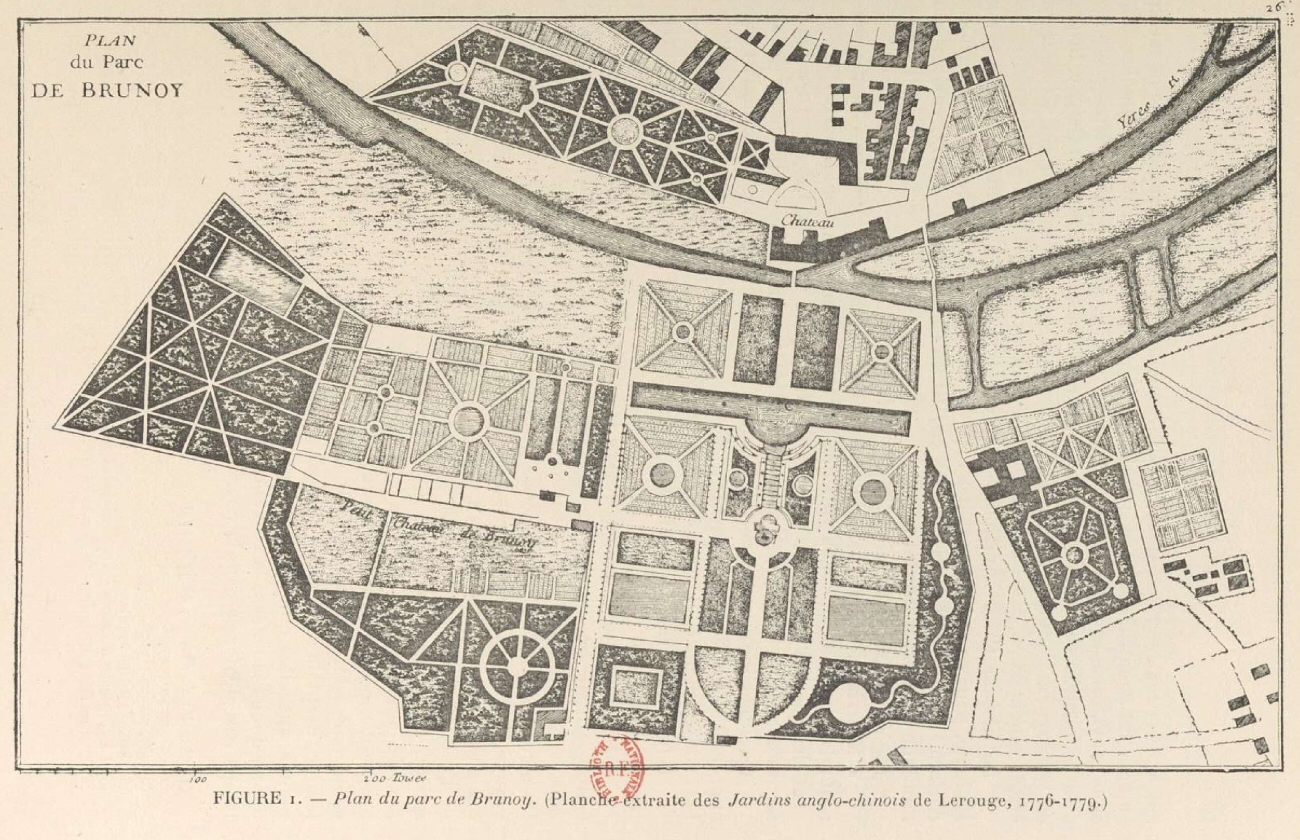
| Plan of the castles and gardens of Brunoy around 1776
|
It seems that Monsieur also considered being able to join Brunoy in this way from Paris, since Memorandum 1 mentions that " this prince thought that if it was possible to establish a galliotte or a coach which would leave Paris, the possessions that he loves would be more alive […]”. The challenge will therefore lie in the ability to make the river navigable between Villeneuve and Brunoy.
Concerning the part located between Brunoy and Crosne, the editors of Memorandum 1 do not see any other major difficulties than the presence of two mills which "Monsieur would be responsible for acquiring", due to the width and depth of the river, considered sufficient.
|
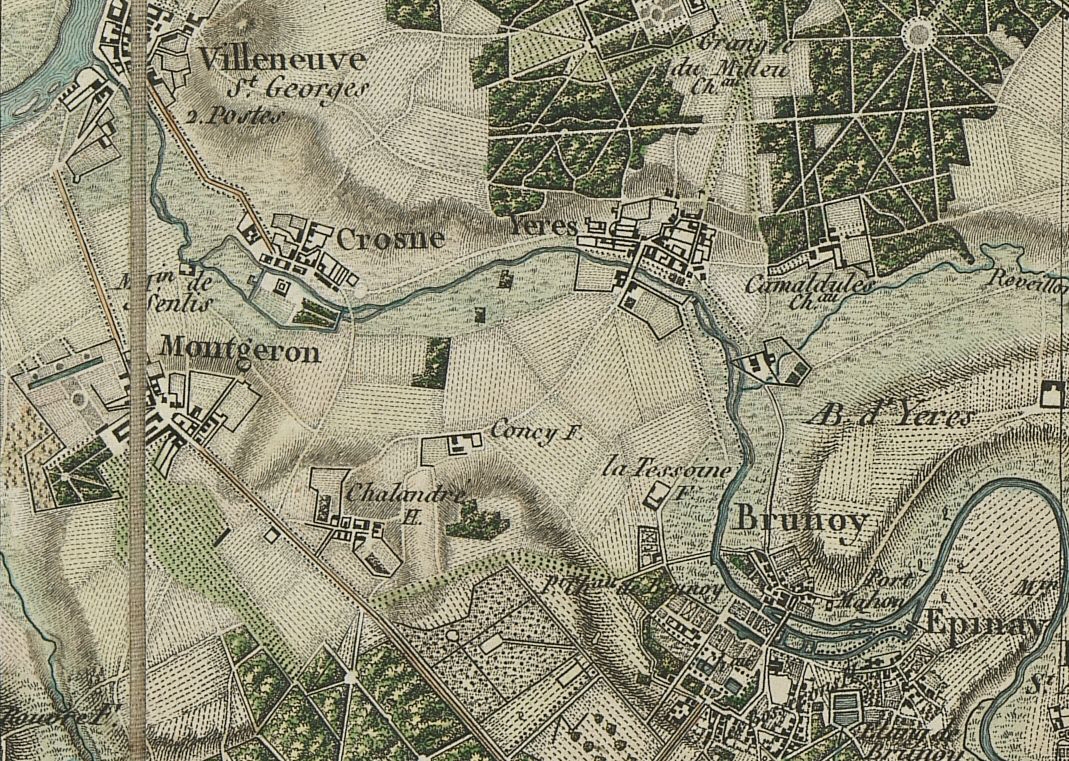
| The Yerres River from Crosne to Villeneuve,
extract from Cassini's Atlas, circa 1740
|
The matter becomes more complicated from Crosne, due to the splitting of the river as it passes through the Crosne castle gardens. Here again, the brief foresees a simple solution via the digging of the river’s bed in its southernmost part, as well as a straightening and widening of its course. The northern part would be left intact, which would also allow the mill located there to be preserved in its original state.
The necessary work is therefore considered relatively unimportant: “we assume that this work would not be very expensive”.
The Memorandum concludes by introducing the idea that the enterprise does not only aim to satisfy the whim of a prince, but that it has also a public utility: “This navigation would provide the greatest advantages to the villages and farms which are above Brunoy and in the surrounding area; transporting foodstuffs would become easy and inexpensive. ". However, the Memorandum mainly emphasizes the personal satisfaction that the king's brother would derive from this achievement that he “ardently desires”: one cannot be more explicit!
|
-
- A questionable public utility
In the letter which accompanies Memorandum 1 and directly formulates the request to Trudaine, Cromot emphasizes the point by recalling that “the Prince takes a real interest” in the matter; the tone used is courteous but does not show any particular deference and clearly conveys the importance of the request. Trudaine made no mistake and annotated the letter before sending it to Perronet, asking him to “promptly put him in a position to respond at least temporarily”.
Cromot also takes up the argument according to which Monsieur's motivation would be "the desire to be useful to a country in which he sometimes inhabits". However, the development of river transport routes was in 1776 not only a fashionable subject but above all a prerogative of his interlocutor Trudaine: in fact, after having been seconded from 1763 to Secretary of State Bertin, river navigation and the development of waterways returned in 1774, under the leadership of Turgot, to the Ponts et Chaussées’ authority14.
River transport experienced huge development from 1740: safer than road, it was also better suited to heavy freight. Bertin, from 1764, sought to make entirely public the management, construction and maintenance of waterways, which was previously entrusted to costly and inefficient concessions. When the Administration of Bridges and Roads regained control on the management of waterways in 1775, it gave impetus to new constructions which reflected the country's growing interest in inland navigation. It has thus been possible to say that between 1760 and 1790, France was “agitated by a hydraulic fever”15.
Is Trudaine really convinced by the economic usefulness of the thing, taking into account the freight likely to pass through the Yerres River once canalized? One can doubt this because, as mentioned in Memorandum 1, the local residents are mainly farmers, market gardeners and wine growers: no mines, harvested timber or any other heavy cargo. Since the paths along the Yerres River are no major commercial routes, the increase in river traffic would hardly lead to any significant economic progress.
This does not prevent Cromot from “trying his luck” in order to finance the approval work of his sponsor with public funds. Being a fine connoisseur of budgetary mysteries and a zealous collaborator, he precedes the desires of his master, who is never left behind when it comes to managing his income: in 1774, he had obtained from his freshly crowned brother that the royal treasury takes charge of all the pensions previously paid into his private coffers16. The “public good” argument for the development of the Yerres river therefore appears above all – if not exclusively – as an issue of savings.
|
-
- Gondolas and ceremonial navigation
The gondola being in our modern collective imagination intimately associated with Venice (Italy), it may seem surprising that Monsieur wanted to reach his castle by this exotic means of transportation. Having spent his childhood in Versailles, he certainly had the opportunity to stroll on the Grand Canal in one of the gondolas making up the flotilla residing on this basin.
Under the Ancien Régime, the gondola was used as a ceremonial or even parade vessel, and Louis XIV, upon the development of the water features of Versailles in 1679, provided the castle with a fleet of gondolas. They were fourteen in 1698: seven of them were “suite gondolas” similar to those in Venice but the others were richly decorated vessels.
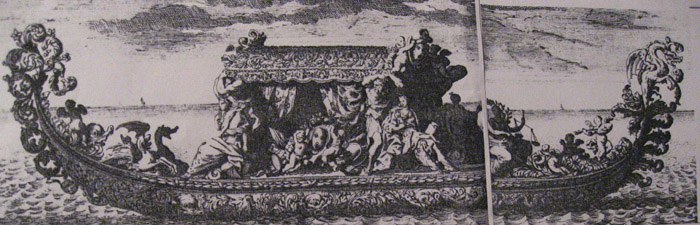
| Le Pautre after Louis Dorigny , Gondola for the Versailles flotilla,
17th century, engraving. Paris, National Library of France,
Department of Prints and Photography, Ed 65
|
To operate and maintain these boats, Louis XIV brought in Venetian boatmen and carpenters who were installed in “Little Venice”. This group of buildings, now partly disappeared, housed in the gardens of Versailles both the shipyard and the staff quarters of the Grand Canal fleet. Built by the architect Antoine Bergeron, they were located between Trianon and the Palace of Versailles, at the eastern end of the Grand Canal, near the Bassin d’Apollon17.
|
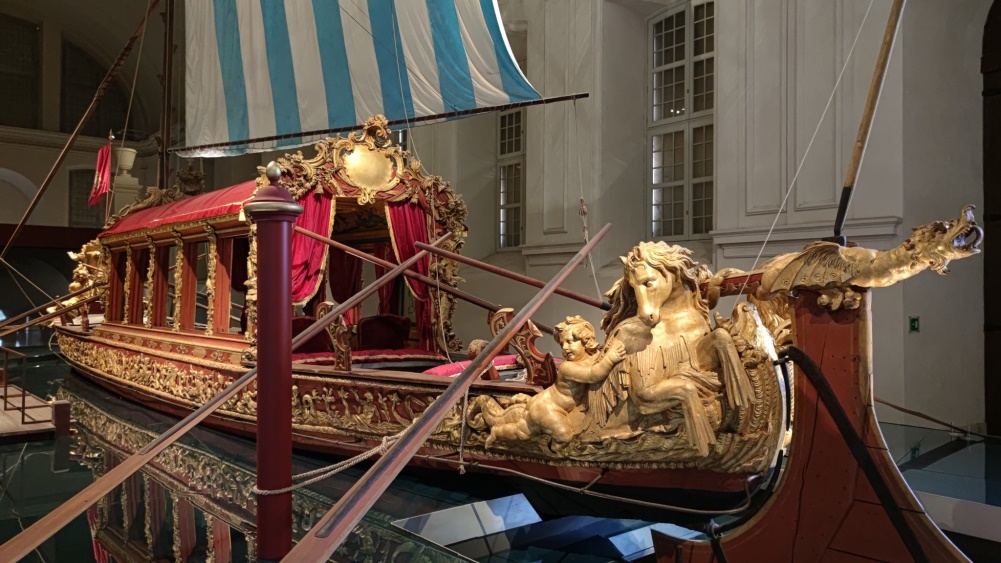
| “Bucentaure” of la Maison de Savoie, La Venaria, Italy
|
Some examples of these ceremonial boats still exist in our time, such as the “Reale” of Louis XIV displayed at the Paris Marine Museum, or the extraordinary “Bucentaure” visible at the carriage museum of the Venaria castle, near Turin.
This magnificent vessel, ordered in 1729 by King Victor Amadeus II, sailed up the Po from Venice to Turin, thus proclaiming the power of the ruling family of Savoy. It is not impossible that Madame, the wife of the Count of Provence, herself from the House of Savoy and having seen this beautiful example during her childhood, influenced her husband's request.
The fleet was used for entertainment cruises, sometimes with the sound of the music played by orchestras on board. Gondolas were often used for these rides, and having regular access to them was a proof of great privilege.
|
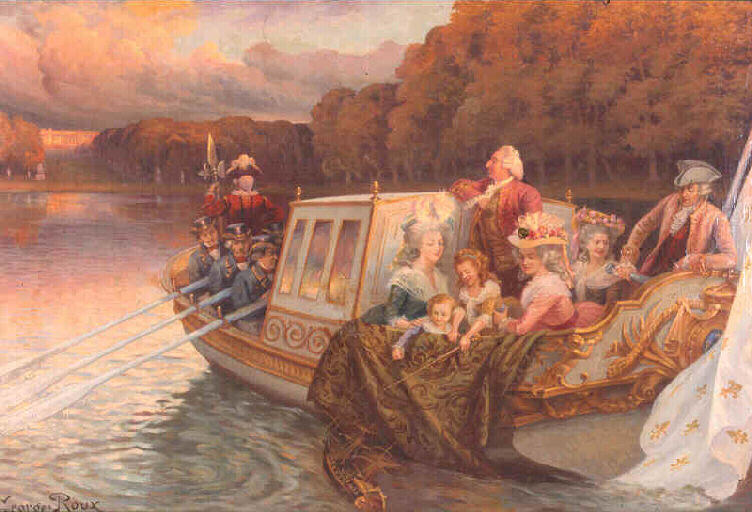
| George Roux (1853-1929). The Royal Family
in a Gondola on the Grand Canal, before 1892.
Oil on canvas. Versailles, musée Lambinet
|
The painting on the right, though being an a posteriori illustration since it dates from the end of the 19th century, gives us an idea of what a journey on the grand canal in one of these ceremonial gondolas could look like.
|
- The difficulties
With his letter 3 of August 21, Cadier dampened general enthusiasm. Indeed, he summarizes to Trudaine and Perronet the difficulties that he was able to identify on the field and introduces Memorandum 2, which details these difficulties.
It appears that the obstacles presented in brief 1 were underestimated:
- There are not two but five mills, as well as several bridges, which are located on the course of the Yerres River within the scope of the project.
- The slope noted (which is not mentioned in Memorandum 1) is not currently compatible with navigation.
- The impact on the Crosne Castle park is more severe than expected.
-
- The reconstructed plan
Furthermore, Cadier relates a conversation with “M. de Cromot and [some] other officers of Monsieur” where he exposed these difficulties and at the end of which they “agreed on the difficulty of executing the project in relation to the expense and the little usefulness”. He finally announces his upcoming Memorandum (2) which will detail the different points, but it already seems certain that Cromot no longer really supports the project: "Mr. de Cromot will put everything before the Prince's eyes to urge him to withdraw from the idea that was given to him and to which it appears that he will not hold, if its execution must cost him more than 20 to 30 thousand pounds.” This sentence is interesting because it suggests that Cromot had given himself a budgetary ceiling not to be exceeded, on the basis of Memorandum 1.
Finally, Cadier mentions that he will annex to his Memorandum a map of which he has instructed two engineers (Gagelin and Didier) to make a copy. Unlike the Memorandum, this map is unfortunately not available anymore. However, as it was very important for understanding the different solutions proposed by Cadier (because he refers to it frequently), we have decided to re-create it on the basis of the information contained in the Memorandum.
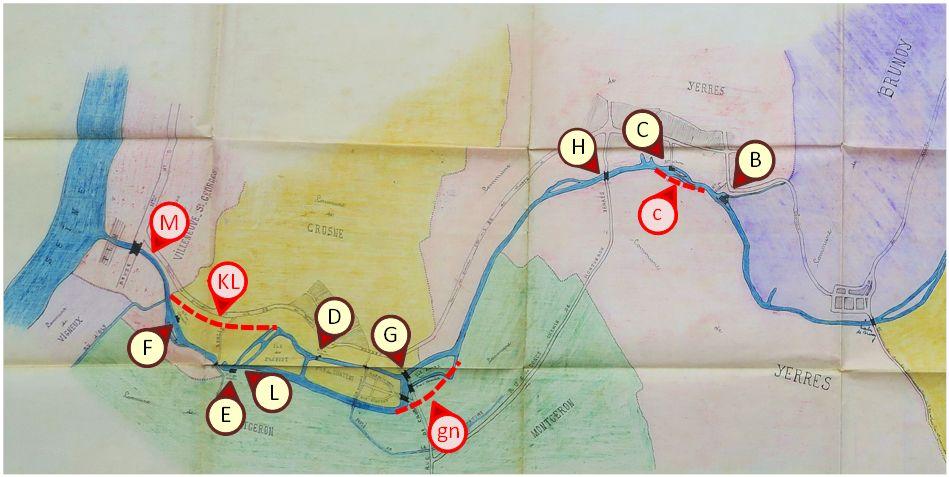
|
Recreation attempt of the original map
|
Legend of the rebuilt-map
| B | Mill known as "de Mézières" belonging to the Yerres Abbey |
H | Brige of Yerres, reconstructed in 1775 |
| C | Mill known as "de Yerres" |
L | Junction between the canal and the outlet river |
| D | Mill known as "de Crosne" |
KL | 1st portion of the canal to be dug |
| E | Mill known as "de Senlis" |
gn | 2nd portion of the canal to be dug |
| F | Mill known as "de Villeneuve-St-Georges" |
c | Site of the first lock, to bypass the mill |
| G | Stone bridge with two arches |
M | Site of the last lock |
For greater readability, we started with a handwritten and colored plan, sufficiently detailed on the part of the course of the river that interests us. The plan is not dated, but the presence of the railway marked “PLM” indicates a creation in the second half of the 19th century. The artisanal – not to say artistic – character evokes the work of a design office, perhaps of a notary or a surveyor.
The main difficulties identified by Cadier relate to the following causes:
- The course of the river: windings unsuitable for navigation and damage to properties crossed,
- The difference in altitude: 20 feet of slope between the Château de Brunoy and the mouth of the Seine,
- The water draft: depth of the river bed and
- The air draft: possible height of passage under bridges
-
- Depth and flow
The problem of the draft is central in the analysis: in fact, as Cadier reminds us, the river " reaches the edges almost everywhere", making the valley at Yerres and Crosne " subject to frequent flooding either by the floods of the Hyere River or by the swellings of the Seine” as for example in the gardens of the Château de Brunoy which “are subject to being flooded at the slightest floods”. These variations in flow also have an impact on the height available under the bridges to pass navigation. Cadier mentions that the level of the Seine is usually 10 to 15
feet18 under the key of the large arch of the Villeneuve-St-Georges bridge but that during the great winter flood of 1741 the water level reached the keystone, and that, during usual winter floods, the water level rises to 12 feet above the lowest water levels, “which then submerges the entire valley […]”. It is therefore necessary to regulate this flow by means of locks, but these must be placed properly to contain the floods… but also to allow navigation to continue during periods of low water!
Cadier first proposes to remove the “de Mézières” mill (B on the plan) belonging to the Abbey of Yerres, on the double grounds that it would be of mediocre performance due to its drop of only 2 feet, but also that its disappearance would make it possible to lower the level of the river around the Château de Brunoy and thus make it less sensitive to floods and to dry out the surrounding marshy land: “The advantage of the healthiness of the air and the drying out of the few marshy parts which are between Brunoy and this mill seem to require this reduction .
So be it. But one is allowed to think that this mill appears more “useable” than others! In fact, the mill of Villeneuve-St-Georges (F) is the property of Cardinal de la Roche-Aymon, prior of the abbey of St Germain, who received the last breath of the late King Louis XV and officiated at the wedding of his successor Louis XVI: no need to say that the expropriation of such a character would not be a walk in the park, even for Monsieur and the skillful Cromot. To a lesser extent, the Crosne mill (D) is an integral part of the castle gardens, property of the Marquis de Brancas, lieutenant general in the government of Provence: here again it is not small fry and it seems a priori easier to put pressure on Yerres Abbey!
The second “sacrificed” mill is that of Senlis (E) while that of Yerres (C), located 200
toises19 downstream from that of the abbey, is preserved. Cadier proposes to bypass the latter through a canal to be drilled 60 toises long (c) in which a first lock would be placed. The second lock would be built upstream of the Villeneuve bridge (M on the map), to regulate the upwelling of the Seine during periods of flooding. This would, however, imply a digging of the river bed between the last lock and the Seine for approximately 400 toises, in order to preserve the navigable character: “since the large arch of this bridge which has an opening of 15 feet, which is in the middle arch and which is only 15 feet high under lock and key is too low for us to be able to raise the water by 8 to 9 feet and leave sufficient height for the passage of water carts or loaded boats.” This would also require, he warns, "a gravel bottom which will need annual maintenance to prevent its congestion due to the small volume of the waters of the Hyère and the flow of the Seine".
-
- Two possible routes
There still remains a difficult passage in the Crosne castle area; at this place, the river divides into two arms: on the right (from upstream to downstream) “a canal lined with masonry and [which] forms the reach of the mill of the place (D)”, on the left “the other [arm] forms the outlet river from the weir and turns around the Crosnes gardens, forming several very winding angles” making navigation difficult. Cadier then suggests two possibilities:
- Either keep the route as short as possible by following the canal, then drilling a section of 500 toises in length (KL on the map) to reach the river along the road from Villeneuve to Crosne
- Either follow the outlet river by opening a part (gn on the map) avoiding the Crosne bridge (G) and straightening the bend in the watercourse
He clearly indicates his preference for the second because the first has many disadvantages:
- Given its proximity to the road, it would be necessary to build a retaining wall 12 feet high and 6 feet thick on the final part of the newly dug canal (KL), which would entail a significant expense.
- The use of the Crosne canal as a waterway would imply the removal of the mill (D) and therefore compensation to the Marquis of Brancas.
- The implementation of the locks would cause a drop in the water level, which Cadier estimates at 5 feet 6 inches and which he doubts whether the walls of the existing canal are strong enough to support.
- Finally, he foresees the impacts of this change in level on “the large frame bridge of Hyère, repaired in 177520 which is made of old wood and which would have to be completely rebuilt anew. » For good measure, he adds that “this same reduction would at the same time require the reconstruction of two or three other bridges which are located between Hyere and the Crosnes mill”.
It seems a little surprising that a drop in the level of the river implies the total reconstruction of the bridges…: we clearly feel Cadier much more motivated by the other proposal!
He therefore proposes to bypass the gardens of the Crosne castle by taking the route of the outlet river and to position a third lock at the Villeneuve mill, thus reducing the fall of each of these locks… and the damage to the various structures encountered (at most he recommends digging the bed of the river over 15 feet in length and 1 to 2 feet in depth under the large span of the Yerres bridge to secure navigation).
Whatever the path considered, the route of the necessary towpath to be created also poses a problem: with an estimated length of 3600 toises, it is on the right side of the river (from upstream to downstream) and would require the construction of a bridge to pass the horses over the canal of the Crosne gardens (in L on the plan) … and then pass "at the bottom of the embankments of the hedges of the castle gardens […] by widening the outlet river of the other side ” then recross “the Crosnes river on the current bridge (G) which would be left to remain ” following a tortuous route. In addition, the marshy terrain implies an elevation of 2 to 3 feet on the path over almost its entire length. As Cadier points out about this part: “[it] will not be the least expense for the execution of the project". And to hammer the last nail into the coffin of the project by providing a summary of the estimated expenses:
- The construction of each of the three planned locks and their discharge gates would cost 60,000 pounds, an expert estimate "based on the known prices of these types of works and given the distance from the freestone for the lateral retaining walls, which could only be made solidly in large sections of sandstone, to be taken from around Melun or Fontainebleau, […] taking into account the fact that it would be necessary to build a spillway and discharge gates at each of the 3 locks”, a total of 180,000 pounds.
- The cost of buying back the two mills of Mézières and Senlis, “ which are said to be leased for 1200 to 1500 [livres] ” is estimated at 60,000 livres
- The construction of the towpath, including the work itself and the repurchase of land on the location of its route, the various " diggings and cleaning-outs " of the river and other compensations (into the details of which Cadier doesn’t go) are valued at 60,000 pounds for the whole
That is a total of 300,000 pounds for “the expenditure at which the execution of the project is provisionally estimated”. As a reminder, Cromot had indicated in substance to Cadier during the interview reported in
letter 321 that Monsieur would not pursue the project if its cost should exceed 20 to 30,000 pounds: the budget has been increased tenfold and then this is only a first estimate.
And to complete the matter, Cadier recalls the disadvantage "common to all navigation canals which communicate with rivers subject to considerable flooding ": navigation would be impossible during periods of flooding, which happens quite frequently as he mentioned before. He even doesn't come back to the public utility argument…
Trudaine, however, takes up again this argument in letter no. 4, which he sends to Cromot on September 13, 1776, accompanied by Memorandum 2 and the associated plan. He insists on the considerable sum of the estimate “given the little usefulness that could be derived from it for Brunois and the surrounding villages » suggesting that he was hardly convinced by the argument. He recommends in passing to his interlocutor to "not allow the Prince to be unaware that the funds which are intended for canal work are even insufficient for works of this type which have been undertaken for the benefit of trade ": therefore no question to provide funds for projects that do not fully meet this criterion or have not demonstrated their usefulness.
In letter 3, Cadier mentioned an additional request from Cromot for which he had delayed: “he was prepared to also to ask for other objects concerning the path around Brunoy, but I tried to postpone the requests at least for this year".
Trudaine, no doubt anxious not to displease Monsieur and vaguely feeling that this other request will be less problematic than the previous one, takes it up on her own: “with regard to the terraces of the straightening of the Chemin de Brunois in its part near the Malesherbes Cross, which Monsieur wishes to be made, I have instructed Mr. Cavier to have workers there after the wood has been felled and removed. “. And to conclude: “I am always very eager to respond to the Prince’s intentions in everything that depends on me”: one should always think about the future….
In fact, Cromot first acknowledges receipt of the letter and the brief (letter 5) and takes note of the end of non-receipt regarding the assumption of responsibility for the work by public funds, which will, according to him, put an end to the project. But he also notes the proposal for work on the Way of the Malesherbes Cross: “He [Monsieur] will be very sensitive to the attention you have given to his other request and the care you take to ensure that we work on it.”
Letter 6 is Cromot’s final response to Trudaine concerning this affair, which closes it definitively. The Superintendent relates having presented the conclusions of the memorandum to Monsieur and confirms the latter's renunciation of the project, but by wording it in terms which confirm his initial hope of having the work financed by others: “[Monsieur] thought, as I had assumed, that the project of making the Hières river navigable from Brunoy to the Seine would entail a considerable expense for the Government, especially at a time when you have very little funds intended for canals.”
However, he takes care to leave the door open for better days: "But if happier times put you in the position of having considerable funds at your disposal which could cope with all undertakings of this kind, Monsieur would be infinitely flattered that you remembered the request. He would be very happy to see one day the execution of a project of which he foresees the real usefulness for the country and which I will not hide from you that he renounces with difficulty. ".
And so, just to remind you that it is not good to displease such a powerful person, he distills a final message: “He has instructed me to thank you for the work that you ordered to be done at the new path to the Malesherbes Cross, and he urges you to be kind enough to have these works carried out as quickly as possible.”
From his past and his connections, Cromot cannot ignore the state of royal finances, which will also be burdened even more severely by support for the American War of Independence: he should therefore not really have considered that this project could be financed by royal funds. From then on, it is not impossible to think that the Superintendent of Finance found himself a little relieved by his abandonment; as we will see later, he will hasten to divert his master's attention towards some less expensive arrangements… at least initially.
Epilogue
Monsieur will therefore not be able to go up the Yerres in a gondola to reach his castle…. This will not prevent him from giving a new sumptuous party in October 1776, a party that the royal couple will honor with their presence: Madame Campan, companion and reader of Marie-Antoinette, notes in her memoirs: “The noblest and most gallant party that was given to the Queen was the one that Monsieur, brother of the King, had prepared for her at
Brunoy22.”
Monsieur will also console himself by having his architect Chalgrin build a magnificent theater attached to the small castle (for a sum very likely exceeding 300,000
pounds!23). For its inauguration in 1780, Cromot will organize another memorable party in which, this time, the King will participate without the Queen, on bad terms with Madame. This absence made it possible to perform somewhat licentious plays in the new theater, which caused a scandal.
The theater was, like the castles, seized as emigrant possessions and sold as national property during French Revolution. They were
dismantled24 and the gardens left abandoned. Monsieur apparently never returned to Brunoy. Trudaine and Cromot did not witness the vicissitudes of the place: the first died of apoplexy in 1777 during a carriage ride on his land and the second, victim throughout his existence of precarious health, passed away in 1786. The only witness remaining today of this adventure: the Yerres River which still flows without being canalized…
TO THE YERRES RIVER
On your shores, charming Hière,
See without trouble, like your waves,
Passing away the days of a loner
Who asks you for rest.
That this field that your water fertilizes
Be for me the limits of the world,
Be for me the whole universe.
Far from mortals and lies,
Let my mind never dream
Than this willow, this poplar
Who covers your wandering water!
Enough your hospitable edge
Grace and freshness abound.
Ah! If possible, ready for your wave
The virtue of making people forget.
Poem by DUCIS, Monsieur's protégé in Brunoy, composed around 177525
References :
4. Machault d' Arnouville (1701-1794) was Controller General of Finances for Louis XV from 1745 to 1754, then successively Secretary of State for the Navy and Keeper of the Seals.
5. MARMONTEL Jean-François,
Memoirs, Edition of Maurice Tourneux, Paris, 1891, t. II, 5, p. 10-11.
6. FÉLIX Joël:
Finance and politics in the Age of Enlightenment. The L'Averdy Ministry, 1763-1768, Paris, Committee for the Economic and Financial History of France, 1999, p. 208, 343, 350, 454, 457, 473.
7. See the fascinating article by Cyrille SCIAMA: “The Count of Provence and his Superintendent of Buildings: an original partnership, 1771-1791 ”, Revue d’histoire moderne et contemporain n°53-03 of 2006, p. 61 to 76.
Available in
CAIRN (in French)
8. DUBOIS-CORNEAU Robert, op. cit. , p.4-5.)
9. "
The Corps of Bridges and Roads - From the conquest of national space to territorial planning, French version of
“Die Ingenieure des Corps des Ponts et Chaussées Von der Eroberung des nationalen Raumes zur Raumordnung", in A. Grelon , H. Stück ( dir .), Ingenieure in Frankreich, 1747-1990 , Frankfurt, New York, Campus, 1994, p.77-99).
10. Preserved in the National Archives under the symbol CP/F/14/8443 to 8507)
12.Deliberations of the Assemblies of Bridges and Roads (1773-1791), National Archives, Reference
F/14/10906/2
13. DUBOIS-CORNEAU Robert,
op. cit., p.17.
14. See on this subject SZULMAN Éric: Inland navigation under the
Ancien Régime – birth of a public policy ,
Presses Universitaires de RENNES, 2014, p.153-177.
16. LEVER Evelyne,
op. cit., p.37.
17. ANTHORE Soline: “An air of Venice in Versailles” in
La revue Château de Versailles, n°10 from July-September 2013, Versailles.
18. 1 foot = 30.48 cm, 1 inch = 2.54 cm.
19. 1 toise = 1.949 m ≃ 6 feet.
20. Bridge indicated at (H) on the plan.
22. Quoted by DUBOIS-CORNEAU Robert,
op. cit., p. 77-78.
23. Estimate in DUBOIS-CORNEAU Robert,
op. cit., p.146-147.
24. The large castle was completely destroyed: only a few outbuildings remain south of Place St-Médard; the small castle has been partially preserved; the theater has now disappeared: it was dismantled and its materials sold in 1792; the actors' house, which survived for a few years, suffered the same fate in the 19th century.
25.Quoted by DUBOIS-CORNEAU Robert,
op. cit. p. 3.